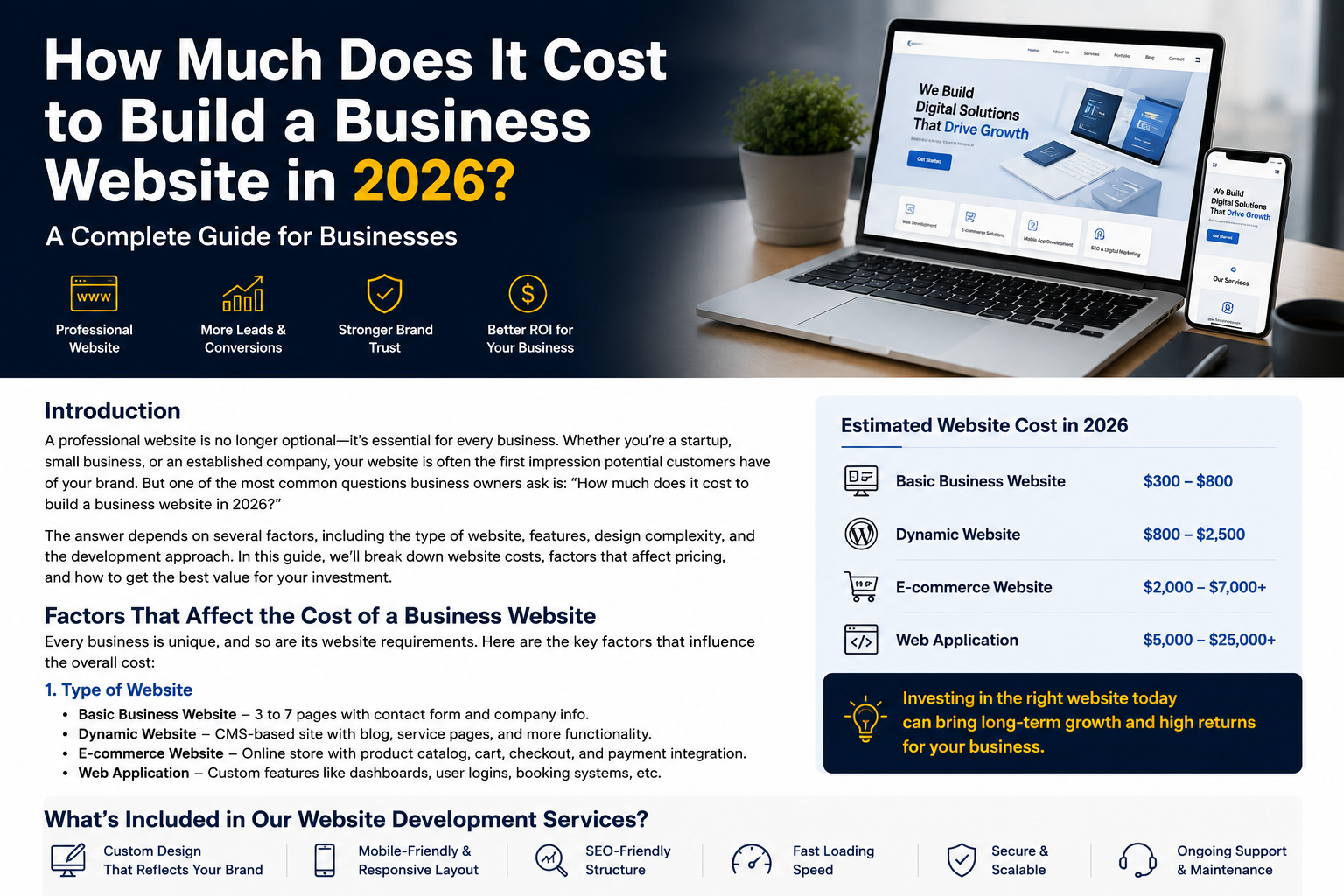
How Much Does It Cost to Build a Business Website in 2026?
A professional website is one of the most important investments a business can make in 2026. Whether you run a small business, professional service company, startup, e-commerce store, or established organization, your website is often the first place potential customers go to learn about your business.
One of the first questions business owners ask is: How much does it cost to build a business website?
There is no single fixed price. Website development costs depend on the type of website, number of pages, design requirements, functionality, integrations, content, SEO requirements, hosting, security, and ongoing maintenance.
Quick Answer
The cost of a business website depends on what you need the website to accomplish. A simple company website can be relatively straightforward, while an e-commerce platform, customer portal, CRM, or custom web application requires significantly more development.
Before choosing a development company, businesses should define their requirements and business goals. This makes it easier to select the right technology, features, development approach, and budget.
What Determines the Cost of a Business Website?
Several factors influence the cost of developing a professional business website.
1. Type of Website
A basic business website may include pages such as Home, About, Services, Portfolio, and Contact. A dynamic website may additionally include a content management system, blog, testimonials, portfolio management, and other features.
E-commerce websites require additional functionality such as products, shopping carts, checkout, payments, orders, inventory, shipping, and customer accounts.
Custom web applications can be significantly more complex because they are designed around specific business processes. Examples include CRM systems, booking platforms, customer portals, dashboards, vendor portals, and SaaS applications.
2. Custom Design
A template-based website can be faster to launch, while a custom-designed website can be created specifically around your brand, customers, and business objectives.
Custom UI and UX design can help businesses create a more professional experience and guide visitors toward actions such as requesting a quote, making a booking, contacting the company, or purchasing a product.
3. Number of Pages
A five-page company website and a large corporate website with dozens of service, industry, case study, and resource pages require very different amounts of work.
Businesses offering multiple services can also benefit from dedicated service pages because each page can target a specific search intent.
4. Website Functionality
Functionality can have a greater impact on development cost than the number of pages.
- User registration and login
- Customer dashboards
- Booking systems
- Online payments
- File uploads
- Notifications
- Advanced search and filtering
- CRM integrations
- Third-party APIs
- Automated business workflows
SEO Should Be Part of Website Development
SEO should ideally be considered during development rather than added after the website is finished.
A business website should have search-friendly URLs, proper heading structures, responsive design, optimized images, metadata, internal linking, fast performance, an XML sitemap, and a structure that allows search engines to crawl and understand the website.
A visually attractive website is not enough if potential customers cannot find it through search engines.
What About AEO and AI Search?
Search is changing rapidly. People increasingly use AI-powered systems to research companies, products, services, and solutions.
Answer Engine Optimization, or AEO, focuses on making website information easier for search engines and AI systems to understand and use when answering questions.
Businesses can prepare for AI-powered search by creating clear answers, useful content, FAQ sections, structured information, service-specific pages, and authoritative business information.
For businesses investing in a new website, considering both SEO and AEO from the beginning can provide a stronger foundation for long-term online visibility.
Mobile Responsiveness Is Essential
A professional business website should provide a good experience across smartphones, tablets, laptops, and desktop computers.
Mobile responsiveness involves more than simply shrinking a desktop design. Navigation, buttons, forms, images, typography, and page layouts should all be designed for smaller screens.
Website Speed Matters
A slow website can negatively affect user experience and may cause potential customers to leave before contacting your business.
Performance can be affected by image sizes, hosting, server configuration, database queries, JavaScript, CSS, third-party scripts, caching, and application architecture.
Performance optimization should therefore be considered during development rather than treated as an afterthought.
Hosting and Deployment
Website development is only one part of launching a successful online presence. The website also needs reliable hosting and proper deployment.
Depending on the project, businesses may use cloud platforms such as DigitalOcean, AWS, or Google Cloud.
A professional deployment may include domain configuration, DNS, SSL certificates, server configuration, database setup, backups, security, monitoring, and deployment automation.
Don't Forget Ongoing Maintenance
A website is not necessarily finished when it goes live. Businesses may need ongoing maintenance to keep the website secure, fast, and compatible with changing technologies.
- Security updates
- Software updates
- Backups
- Performance monitoring
- Bug fixes
- Content updates
- SEO improvements
- Server maintenance
- New features
Should You Choose the Cheapest Website?
The cheapest option is not always the most cost-effective option.
A low-cost website may be perfectly suitable for a small business that only needs basic online visibility. However, businesses expecting their website to generate leads, process orders, integrate with other systems, or support business operations should consider long-term requirements.
Before hiring a development company, ask whether the website will be mobile responsive, SEO-friendly, secure, scalable, maintainable, and capable of supporting future business growth.
How to Reduce Website Development Costs
Businesses can control development costs without sacrificing important functionality.
Start With the Most Important Features
You do not necessarily need every feature on day one. Launch the core functionality first and add advanced features as your business grows.
Prepare Your Content
Having your company information, services, images, branding, and other content ready can make the development process more efficient.
Define Requirements Before Development
Changing major requirements during development can increase both project costs and delivery time. Clearly define your required features before development begins.
Choose Technology Based on Requirements
The right technology depends on project complexity, scalability, performance, integrations, development requirements, and long-term maintenance. Technology should be selected according to the business problem rather than popularity alone.
What Should a Professional Business Website Include?
A strong business website should generally provide:
- Clear information about the business
- Professional branding
- Mobile-friendly design
- Fast performance
- Clear calls to action
- Search-engine-friendly structure
- Secure hosting
- Easy navigation
- Contact and inquiry options
- Analytics
- High-quality content
- Scalability for future growth
How to Choose a Website Development Company
When hiring a development company, businesses should not compare providers based only on price.
Review Their Portfolio
Look at previous projects and determine whether the company has experience with websites and applications similar to what you need.
Check Technical Expertise
A professional development team should understand frontend development, backend systems, databases, APIs, hosting, security, and deployment.
Consider Communication
Clear communication throughout the project can prevent misunderstandings and unnecessary changes.
Think About Scalability
Ask whether the website can be expanded as your business grows and whether new functionality can be added later.
Ask About SEO
Your website should be built with search visibility in mind from the beginning rather than treating SEO as something to add after development.
Ask About Support
Find out what happens after the website launches. Ongoing technical support can be valuable for businesses that depend on their website for leads, sales, or daily operations.
Final Thoughts
There is no universal price for a business website in 2026 because every business has different requirements.
A simple company website may only require professional design, responsive pages, contact forms, and basic SEO. A larger organization may need e-commerce, customer accounts, dashboards, payment processing, integrations, automation, and custom software functionality.
The most important question is not "What is the cheapest website I can get?"
Instead, ask: "What website does my business need to achieve its goals?"
Once your requirements are clear, a professional development team can recommend the appropriate technology, features, hosting infrastructure, and development approach.
If your business needs a new website, website redesign, custom web application, or scalable digital solution, the right development partner can help turn your requirements into a practical technology solution.
Frequently Asked Questions
How much does it cost to build a business website in 2026?
The cost depends on the website type, design, functionality, integrations, SEO requirements, hosting, and ongoing support. A simple business website will generally require significantly less development work than an e-commerce platform or custom web application.
How long does it take to build a business website?
Development time depends on the project's scope. A simple business website can be completed much faster than a website requiring custom functionality, integrations, dashboards, payments, or complex business workflows.
Should my business website be optimized for SEO?
Yes. SEO should be considered during website planning and development so that the website has a strong technical foundation for search visibility.
Does my business need AEO?
Businesses that want to increase their visibility across AI-powered search and answer engines should consider AEO alongside traditional SEO.
Should I choose a template or custom website?
A template can be suitable for businesses with simple requirements. A custom website can be a better choice when branding, user experience, integrations, scalability, or unique business functionality are important.